

The stone spheres of Costa Rica are one of the most fascinating and enduring mysteries in Central American history. Over 300 huge, stone spheres have been found on the Diquís Delta and on Isla del Caño, and their purpose, age and importance is debated to this day.
Known locally as ‘bolas de piedra’ (‘stone balls’), the enormous stone spheres are not natural creations, but man-made sculptures, believed to date between 200 BC and 800 AD. Archaeologists believe they could be a creation of the extinct Diquís culture, a pre-Columbian indigenous culture that grew in Costa Rica from 700 AD to 1530 AD, making them the most important, and most renowned sculptures of the ‘Isthmo-Colombian’ area.
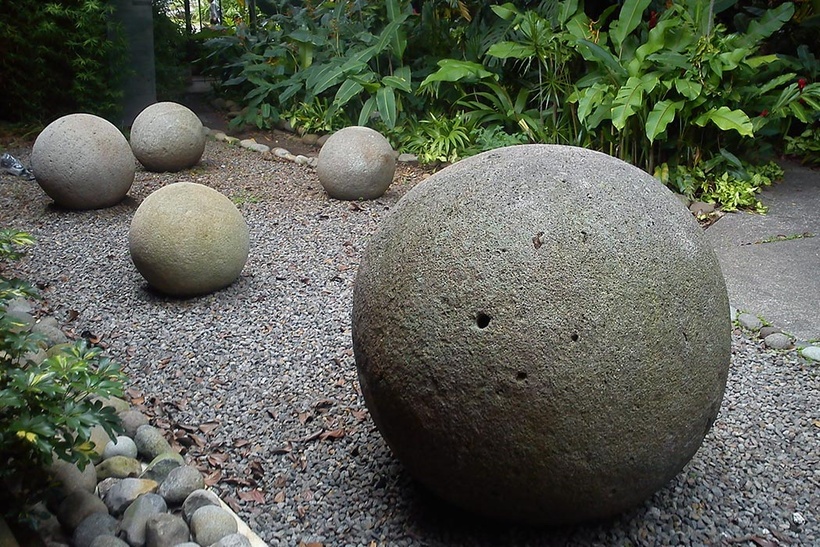
Stone spheres in the National Museum of Costa Rica. via WikiMedia Commons
The spheres remain a mystery, due to the lack of written records from the Diquís culture. According to Professor John Hoopes, ‘The culture of the people who made them became extinct shortly after the Spanish conquest. So, there are no myths or legends or other stories that are told by the indigenous people of Costa Rica about why they made these spheres.’[1]
The spheres vary in size, from small ping-pong ball size[2] to over 6ft in diameter, weighing up to 15 tonnes. The majority of the spheres are carved from gabbro, a similar rock to basalt, but others have been identified as being limestone and sandstone. Making an enormous ball from stone doesn’t appear to be the most difficult task today, but historically speaking, creating such large, smooth surfaces, and in such volume was an enormous and labour intensive task, which makes their existence all the most fascinating when we consider their purpose. Spoiler: Of course, there’s going to be an alien argument soon.

Via yabachigui.com
The construction of the spheres seems to have been more complex than grabbing a mallet and a huge group of workers. General consensus is that the spheres were made by hammering existing natural boulders into shape, often combining them with other rocks, then shaping and finishing them with sand. Much like many other ancient stone monuments from around the world, the source of the material – being gabbro – was several kilometres away from the final installation site. The indigenous peoples who created these stones did not possess adequate leverage, wheels or animals strong enough to lift and relocate the materials to such a distance.
Originally, there may have been hundreds of these stone spheres around the Diquís Delta of Costa Rica, with some scholars believing they may have been used to mark the approach to houses owned by chiefs, however no one is certain. In terms of worldwide study and attention, no one paid the spheres much attention until the 1930s/40s when the United Fruit Company was working to clear areas of jungle to create banana plantations. In the process, the company’s workforce moved the stones, damaging many in the process, using heavy machinery to clear the area.
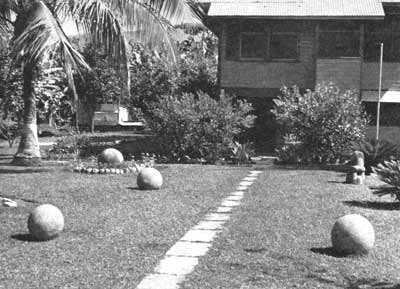
Stone balls decorate the lawn of a banana plantation owner in 1955. via naturalhistorymag.com
The first scientific investigations of the petrospheres (a stone object shaped by human hands) took place in 1943, shortly after the spheres’ ‘discovery’ by Doris Stone, a relation of a United Fruit executive. While such ‘firsts’ and ‘discoveries’ are cited for their scientific importance; indeed, the first paper or study of a site is very important for the continued understanding of heritage and antiquities. However, to credit an America executive’s daughter with ‘discovering’ stones that had been an established part of Costa Rican culture for centuries seems a little unpleasant. I’m no ethics expert by any stretch of the imagination, but the celebration of Western or American/European intervention being the only relevant date in a site’s existence seems a little dismissive of the community who grew around the site.
Despite any semantic unease, the initial study led to a number of later expeditions and digs relating to Costa Rican heritage and may have ultimately led to the preservation of the stones in the face of destructive, industrial progress.
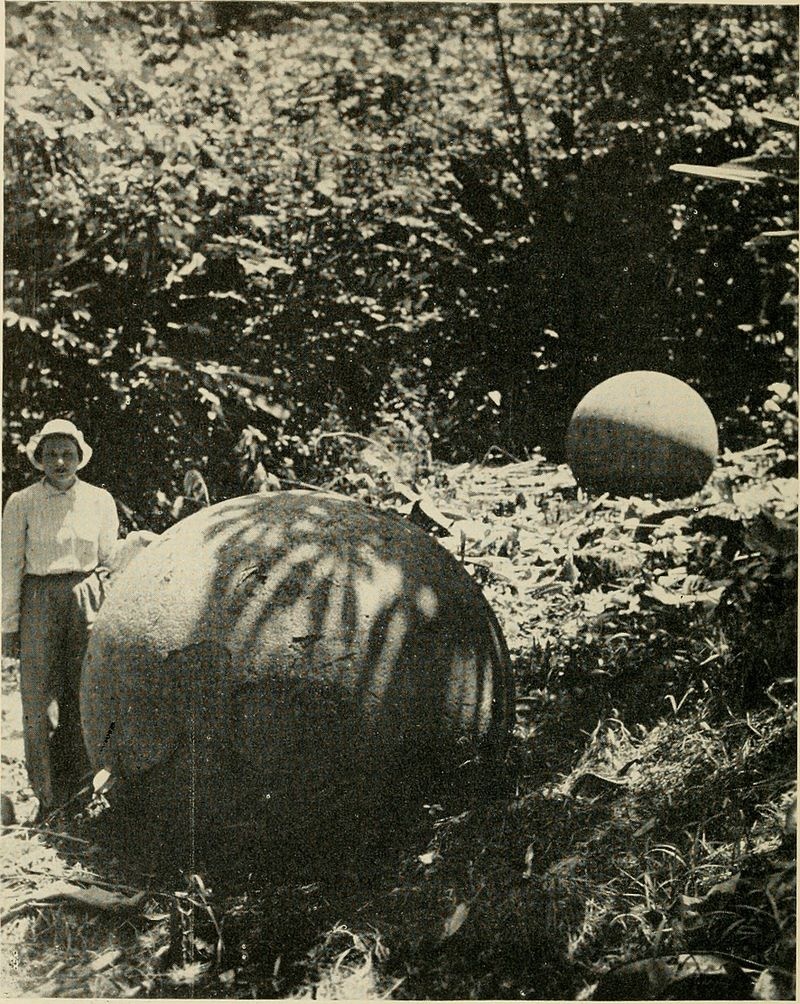
Stone balls in the Terraba Plain, the Boruca region, Costa Rica. Smithsonian Institution. Bureau of American Ethnology, 1948. (Courtesy Doris Stone)
We don’t know how many stones were originally created, how many there are today, and how many have been lost, but it won’t be an insignificant number. It’s estimated that only 10% of the stones remain in their original location.[3] Shortly after the banana company entered the area, rumours circulated that the stones may contain precious metals (Similar rumours have been associated with the destruction of artefacts, graves and human remains throughout time.) and some workers went on to use explosives to destroy the rocks in this fruitless search for buried treasure. Local authorities would eventually intervene to protect the remaining spheres, but by this time, the workmen had destroyed a large amount of spheres. Thankfully, some of the stones that were destroyed at the hands of workers with dynamite have been reconstructed by the National Museum of Costa Rica and can be viewed once again in their whole form.
The remaining spheres continue to be studied by visiting scientists, many other examples have been moved and rehomes as decorative objects, and object d’art in the gardens of local homeowners. As such, with so few remaining in their original positions, it’s clear why scientists and archaeologists are unsure what their original placement was, and if it had any great significance. Despite this causing frustration for many academic bodies, the spheres have since become a celebrated icon of Costa Rica, with several stones installed within government buildings as a symbol of their national identity. Finally, in June 2014, the Stone Spheres of Costa Rica were added to the list of UNESCO World Heritage Sites and formally recognised as a unique and irreplicable site.
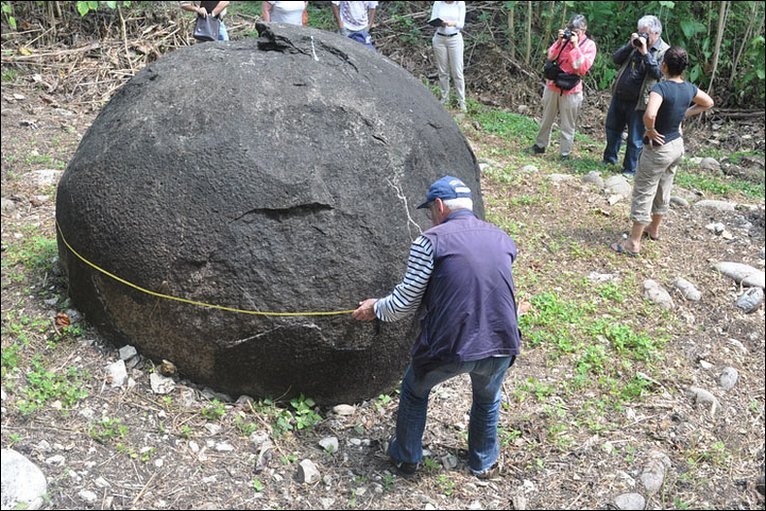
Image via BBC
However, when the craftsmanship, beliefs and heritage of a site isn’t enough for you, it’s time to bend an entire culture’s history and wheel in the aliens. As said by the Costa Rica News, ‘Because of their size, bulk, and precision, many believe that it’s impossible that indigenous tribes created and positioned these colossal stones, many of which are 7 feet in diameter and weigh 20 tons.’[4] Local legends state that some inhabitants once had the power to soften rock, thus enabling others to easily create the shapes.[5] Similarly another local legend is that the spheres were used as cannon balls by Tara or Tlatchque, the god of thunder, and were used to fight Serkes, the gods of hurricanes.

Another theory is that the spheres are a remnant of the lost civilisation of Atlantis, or were left by a departing Alien race. According to everyone’s favourite History Channel show, ‘Ancient Aliens’, parallels can be drawn between the spheres at Costa Rica and similar stone spheres found in Bosnia Herzegovina near Banja Luka. These spheres could be seen as star maps, rolled around to mimic the position of constellations or planets. Or, according to Philip Coppens, the spheres could have been used to ‘concentrate thought. They were physical devices, that somehow by touching or working with these stones, were able to establish a bridge to another dimension.’[6] The places where the spheres were located were then ‘power spots’, whereby energy could be harnessed via mental focus, and the user could be ‘transported to another world where we could communicate with the gods.’
I mean, it’s an option…right?

Finca 6 spheres. via onetwotrail.com
In recent years, a CNN report quotes that studies into an area known as Finca 6 created promising interpretations, viewing the stones a little like Stonehenge, namely as a large clock. In this site, six buried spheres align perfectly with the rising sun twice a year. Therefore, this collection of spheres could be seen as a rudimentary way of measuring time.[7]
Aliens or ancient decoration, the stone spheres of Costa Rica are a piece of heritage to be celebrated for centuries to come.
***

Liked this post? Then why not join the Patreon clubhouse? From as little as £1 a month, you’ll get access to tonnes of exclusive content and a huge archive of articles, videos and podcasts!
Pop on over, support my work, have a chat and let me show you my skulls…
www.patreon.com/burialsandbeyond

Liked this and want to buy me a coffee? To tip me £3 and help me out with hosting, click the link below!
https://ko-fi.com/burialsandbeyond
***
References:
[1]https://www.ancient-origins.net/unexplained-phenomena/giant-stone-spheres-costa-rica-00818
[2] According to author David Childress, some of these examples have been found as grave goods in the burial sites of local chiefs.
[3]https://edition.cnn.com/videos/world/2015/02/05/spc-gt-pkg-mann-costa-rica-stone-spheres.cnn
[4]https://thecostaricanews.com/aliens-or-atlantis-who-made-costa-ricas-stone-spheres/
[5] While some acids could be used to melt limestone, gabbro is an acid-resistant rock.
[6] https://www.youtube.com/watch?v=a7h3lZzICe0 Ancient Aliens s9
[7]https://edition.cnn.com/videos/world/2015/02/05/spc-gt-pkg-mann-costa-rica-stone-spheres.cnn
Additional image sources:
https://www.yabachigui.com/2016-12-31/discover-legacy-pre-columbian-stone-spheres
https://blog.onetwotrail.com/journal/stone-spheres-of-costa-rica
 Burials & Beyond
Leave a comment