

Now that’s a clumsy old title isn’t it? However, today’s photo postcard ‘off’ve the past’ is named exactly that. Digging once again into my collection of graves, memorials and general ‘deathly tat’, I found this particular little photo postcard of a rather pretty little 19th century grave.
While most photographs of graves are generally taken by family members and not intended for public circulation, images of notable peoples’ resting places have long been enjoyed countrywide. So, with this image being a pre-print with a title, it had to belong to someone interesting, surely? But ‘Grave in Field, Oldfield’ seemed to be such a bizarre, nondescript way to describe it.

The epitaph of the field grave reads:
In Memory Of
Mr James Mitchell. Late
proprietor and Occupier of Oldfield House. Who died on the
27th Day of January 1835,
Aged 72 Years.
James Mitchell was born in London in 1762. His parents were both from Halifax in Yorkshire, but appear to have both died when James was a young boy. As poor law dictated, he was probably sent back to his parent’s birthplace in order to receive a level of rudimentary government-subsidised care.

At the age of 12, James had been apprenticed to a specialist gardener, regarded as a nurseryman and planter. Through this work, he would learn how to propagate trees for use in orchards, woodland or grand gardens. By the age of 24, James was fully immersed in the life of a woodsman, and returned to London to work in Enfield Chase. The Chase was once a large ancient woodland and hunting ground, and an undoubtedly beautiful place. Sadly, after the enclosure acts of 1777, the Chase was to be cleared and completely deforested, with ancient oaks torn up in the name of progress and changing land ownership. James was to call London home for the following four years, until his work chopping down the Chase was complete and he returned north to work for landscape designers (posh gardeners) William Emes and John Webb. James spent many years in their service and continued to work for Webb as a foreman, following the death of William Emes.

The landscaping jobs od Emes and Webbs were a far cry from the deforestation efforts of Enfield Chase. As a landscape gardener foreman, he worked on some of the grandest gardens of the day, including Frampton Court in Dorset, whose gardens were designed by none other than Capability Brown.
As James grew in seniority, he soon found himself to be a specialist in demand. Over a decade after starting work with Webb and Emes, he was sent to work (under a stewardship) at a large property in Sussex. Stansted Park had been in a ruinous state for several years, but had once been the grand seat of the Earl of Halifax, and James was able to return it to its former glory. Over several years, James toiled at the fixer-upper, planting trees, improving roads and rebuilding farms, collecting quite the bank balance in the process.
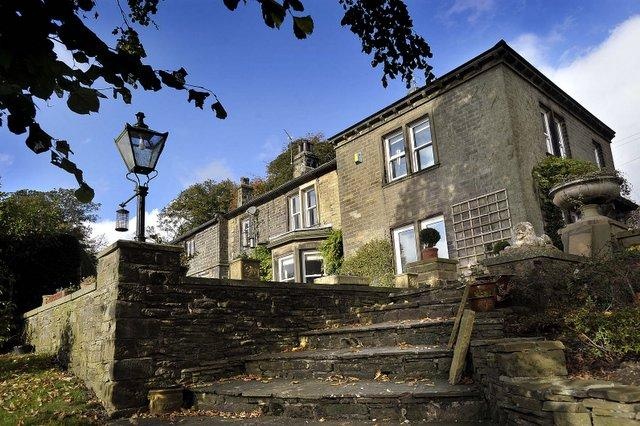
James would retire in 1820 at the age of 58 and bought the 14-acre Oldfield House and Farm in Keighley (now Grade II and was listed for £475,000 when last on sale in 2010). Here he extended and completely revamped the property, styling the gardens like a small country estate, with large statues placed throughout. He was also able to sit down and condense his experience and knowledge into a substantial tome, titled ‘Dendrologica; or a Treatise of Forest Trees’ in 1827. While little is known about James’ character, I think we can agree he was anything but stuffy; on the title page of his work, he names himself J Mitchell, F.J.B.S & M.N.A… meaning Fellow of John Bull’s Society and Master of No Arts.
His bequests upon his death were just as precise as his horticultural work, stating that he should be buried on a small mound close to his house, with the plot marked with a stone wall and a Hawthorn tree in each corner.

The folk beliefs surrounding Hawthorn trees are multitudinous and conflicting, and while James may have viewed them as symbolising hope and goodness (as the blossoms were used to decorate doors on May Day), other communities linked the blossoming tree with death. Indeed, many people regarded the Hawthorn as growing ‘dead men’s blossom’, due it its powerful and not entirely pleasant smell. As such, few houses in the north would allow Hawthorn blossom into their house, lest it bring bad lock and tragedy along with its powerful whiff.
Thankfully, the Keighley News website was able to reassure me of one thing – James’ grave is still there. In between the walls of ads and pop ups that blight regional news sites, were some recent photographs of the gravesite, and what a gothic sight it is!
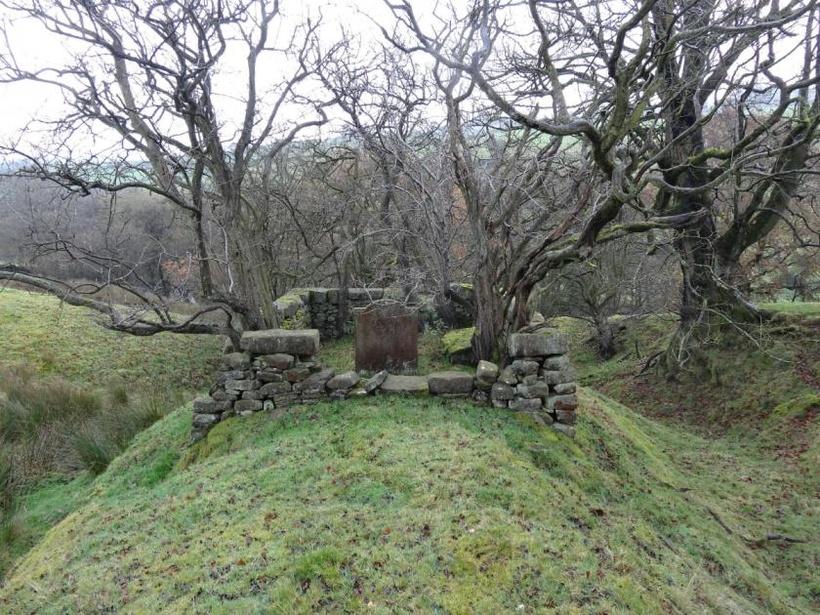
In a crumbling stone enclosure, with each corner flanked by a large Hawthorn tree, sits James’ grave. The original large stone that was once placed on his grave – presumably to deter grave robbers – has since been removed and propped against a wall, perhaps to aid with mowing. A local legend tells of how a large boulder was rolled from the house, down into the valley, with James saying that wherever it came to rest should be his gravesite. While this tale is repeated as fact, I’m unconvinced as to this story’s legitimacy – while it may have worked for Robin Hood and his arrow, chucking boulders about doesn’t seem the best way to determine grave placement, and seems to be the type of romantic story spun long after the death of the subject.

According to a 1979 newsletter from The Friends of Dales Rail, Pat Bottomley recalled that ‘Another version was that carrying huge stones from the quarry across the valley by cart proved really difficult. One stone was too big and Mr Mitchell ordered the men to leave it on the grassy mound where the ‘Old Gentleman’s Grave’ is now. He then gave each man a shilling and shared a 70 year old barrel of ale between them saying that when he died he wished to be buried next to the huge stone.’
Another nail in the coffin of this secondary stone theory is that a 70-year-old barrel of ale would be undrinkable. Perhaps if James had tried to feed it to his helpers, they’d have killed him themselves…
Tumbling rocks or not, James Mitchell continues to rest peacefully, spending eternity surrounded by the trees and property that he adored so much.
***

Liked this post? Then why not join the Patreon clubhouse? From as little as £1 a month, you’ll get access to tonnes of exclusive content and a huge archive of articles, videos and podcasts!
Pop on over, support my work, have a chat and let me show you my skulls…
www.patreon.com/burialsandbeyond

Liked this and want to buy me a coffee?
To tip me £3 and help me out with hosting, click the link below!
https://ko-fi.com/burialsandbeyond
***
More info:
https://www.thetelegraphandargus.co.uk/news/8463835.passing-on-a-beloved-oldfield-home/
 Burials & Beyond
Leave a comment