

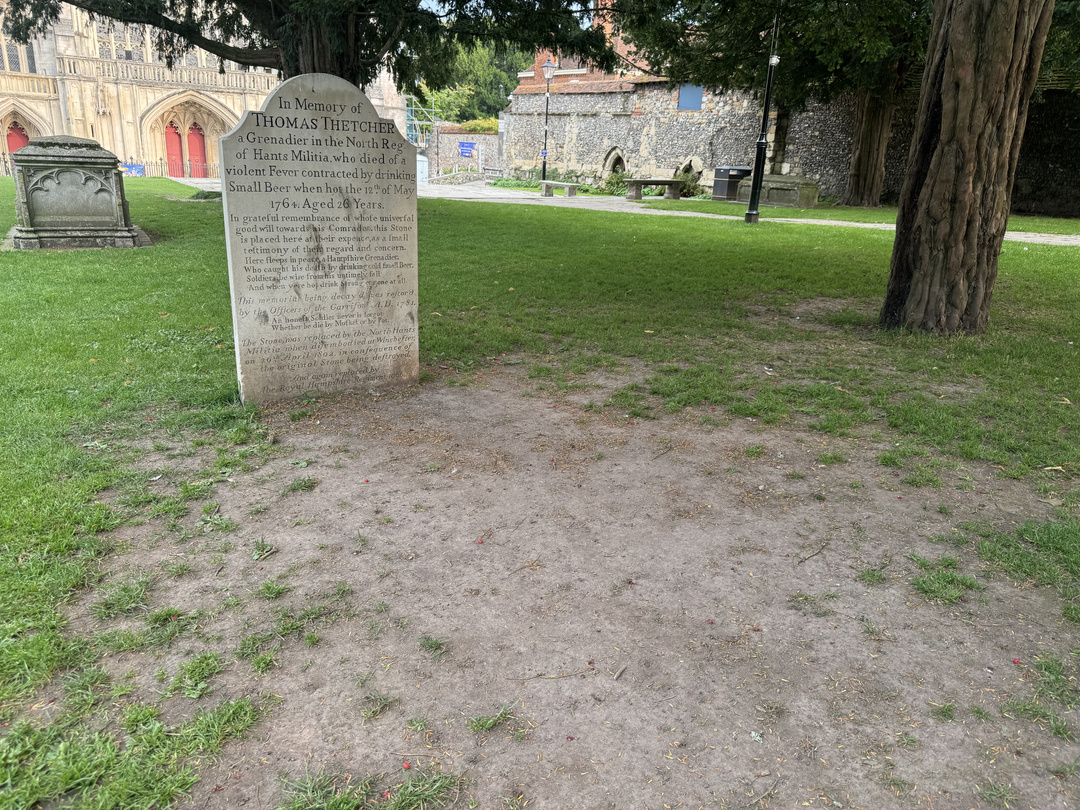
One of few remaining headstones in the grounds of Winchester Cathedral, the grave of Thomas Thetcher has been a beloved sight -and curio – for centuries.
For all intents and purposes, this grave is rather standard in construction – a simple rectangular marker with a hefty 18th century epitaph. But it’s the epitaph that makes this grave so special.
Thomas Thetcher, also known as the Hampshire Grenadier, died in 1764 and has become something of a local celebrity and historical curio thanks to both his epitaph and the nature of his death.

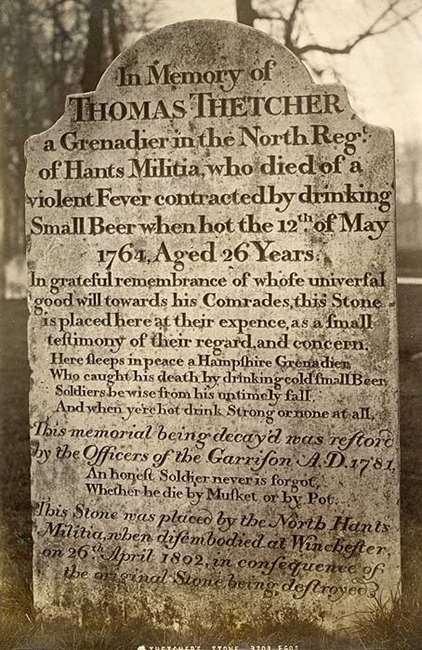
His hefty epitaph reads:
“In Memory of
Thomas Thetcher
a Grenadier in the North Regt. of Hants Militia, who died of a violent Fever contracted by drinking Small Beer when hot the 12th of May 1764. Aged 26 Years.
In grateful remembrance of whose universal good will towards his Comrades, this Stone is placed here at their expense, as a small testimony of their regard and concern.
Here sleeps in peace a Hampshire Grenadier,
Who caught his death by drinking cold small Beer,
Soldiers be wise from his untimely fall
And when ye’re hot drink Strong or none at all.
This memorial being decay’d was restor’d by the Officers of the Garrison AD 1781.
An Honest Soldier never is forgot
Whether he die by Musket or by Pot.”
That’s one hell of an epitaph, but most importantly – he was killed after drinking ‘cold small beer’? Now small beer isn’t just a tiny drink, but refers to a low-alcohol larger or ale that was cheap and easily brewed at home. As for cold, well, it was a hot day, so it stands to reason! Small beer is a vague term for largely home-brewed, low-alcohol beer, which had been a popular drink since the medieval period. Over the centuries, it became a drink consumed by all ages as it was largely regarded to be far safer than water. While water could carry diseases such as typhoid and cholera, the brewing process killed bacteria and was, in theory, a safe bet. However, while it is often theorised that the beer that killed Thomas was poorly brewed and subsequently carried such diseases, many contemporary historians believe that it was either the uncleanliness of the cask used for storing the beer or the drinking vessel itself which killed him. Pub hygiene standards weren’t the highest in the 18th century, so there are multiple suspects to consider in Thomas’ sad case. Either way, if poor Thetcher had drunk a stronger beer or spirit, chances are, he’d have lived.
Thetcher’s 1764 stone isn’t technically original, having ben replaced and repaired in 1802 and then removed for preservation in 1966 (this stone can be seen at the Royal Hampshire Regimental Museum at Serle’s House in Winchester). Subsequently a second facsimile was made and re-installed in the cathedral grounds, which is the one we see today.

And while the grave has regular visitors from local military historians and museum groups, Thetcher’s grave possesses a great and unexpected link to a famous American recovery programme. When a young American soldier called Bill Wilson visited Winchester in 1918, the image of Thetcher’s ominous grave stuck in his mind. When heavy-drinking Bill gave up alcohol and formed Alcoholics Anonymous years later, he remarked in his famous AA ‘Big Book’ that Thetcher’s grave was ‘an ominous warning which I failed to heed.’ Today, occasional sobriety tokens are left on Thetcher’s grave, celebrating both their achievement and memorialising those whose lives were lost to drink.
As always, I was thrilled to visit Thomas and spend a little time in the beautiful grounds in which he spends eternity.
***

Liked this post? Then why not join the Patreon clubhouse? From as little as £1 a month, you’ll get access to tonnes of exclusive content and a huge archive of articles, videos and podcasts!
Pop on over, support my work, have a chat and let me show you my skulls…www.patreon.com/burialsandbeyond

Liked this and want to buy me a coffee?
To tip me £3 and help me out with hosting, click the link below!
https://ko-fi.com/burialsandbeyond
***
 Burials & Beyond
Leave a comment