
Let’s visit one of the most striking graves in the whole of England, nestled in the centre of a city cemetery in north west Leeds. Lawnswood Cemetery was opened in 1875, and is an archetypal example of a sculpted Victorian burial space. With most grounds and buildings designed by architect George Corson (who is also buried on site), the cemetery swirls with grand avenues and leafy plots, the likes of which would have impressed any Victorian horticulturalist. Lawnswood could also boast the first crematorium in all of Leeds.
However, for all of Lawnswood’s thousands of interments, few are listed as having national architectural or artistic interest. Yet in 1911, a woman named Ethel Preston was buried on site, with her grand memorial swiftly garnering national interest. It’s a historic curiosity whenever specific graves become tourist attractions, and a rather exciting one when it results in the production of postcards and novelties, but Ethel Preston’s resting place inspired just that.
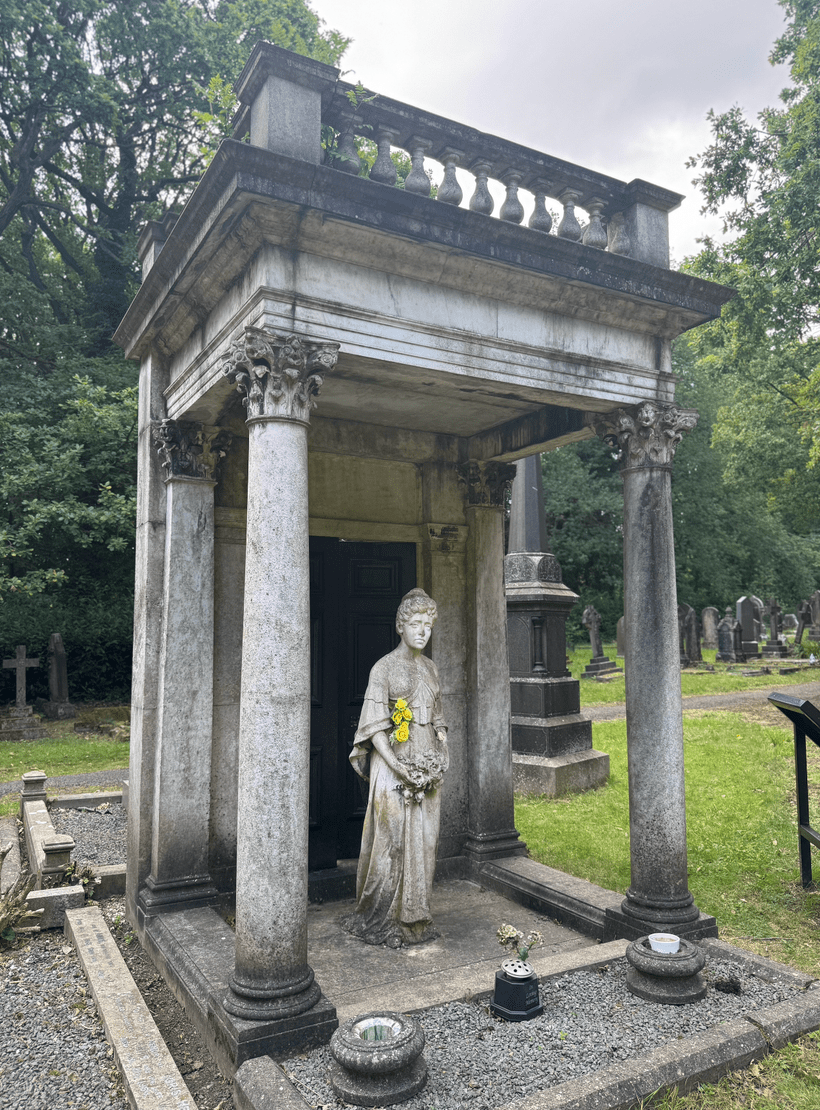
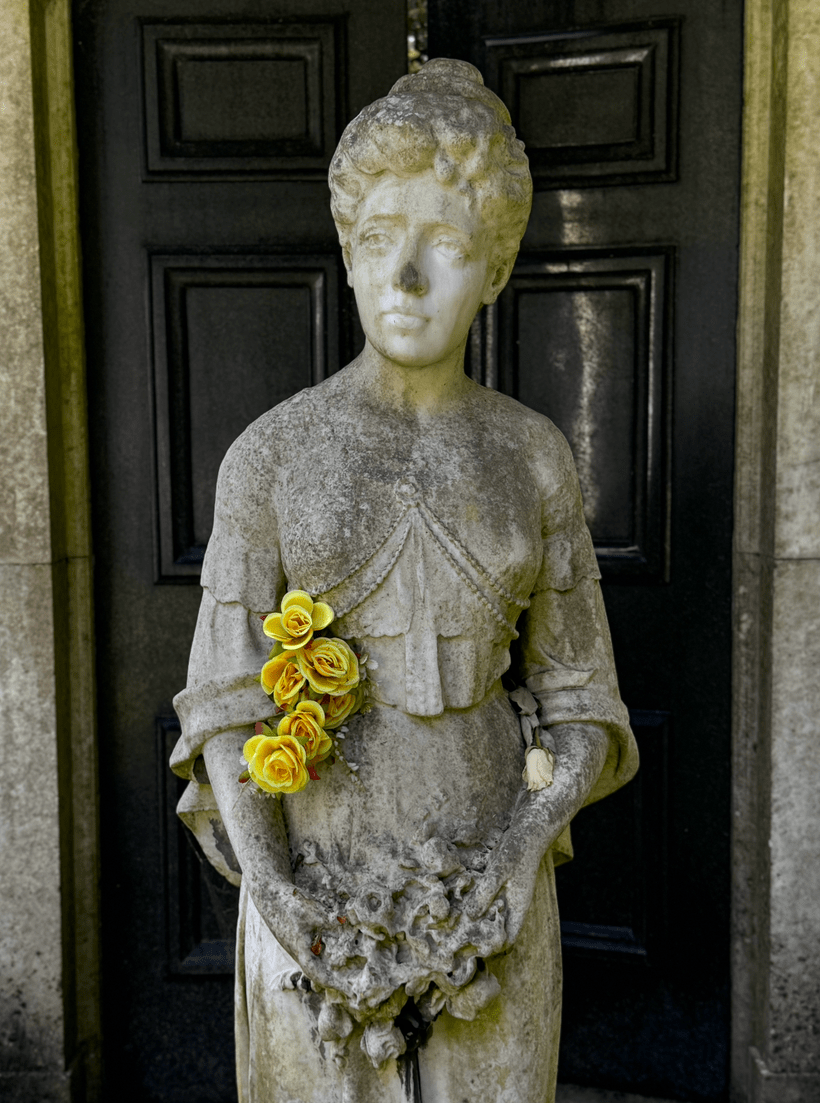
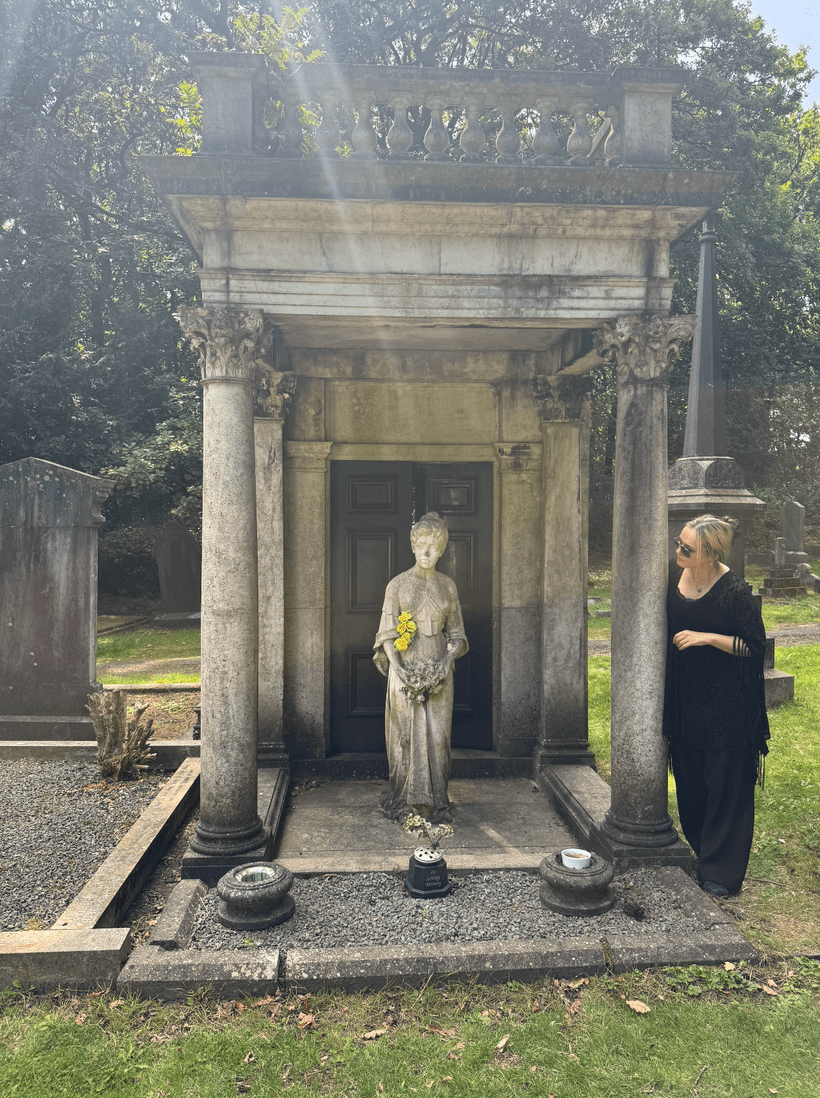
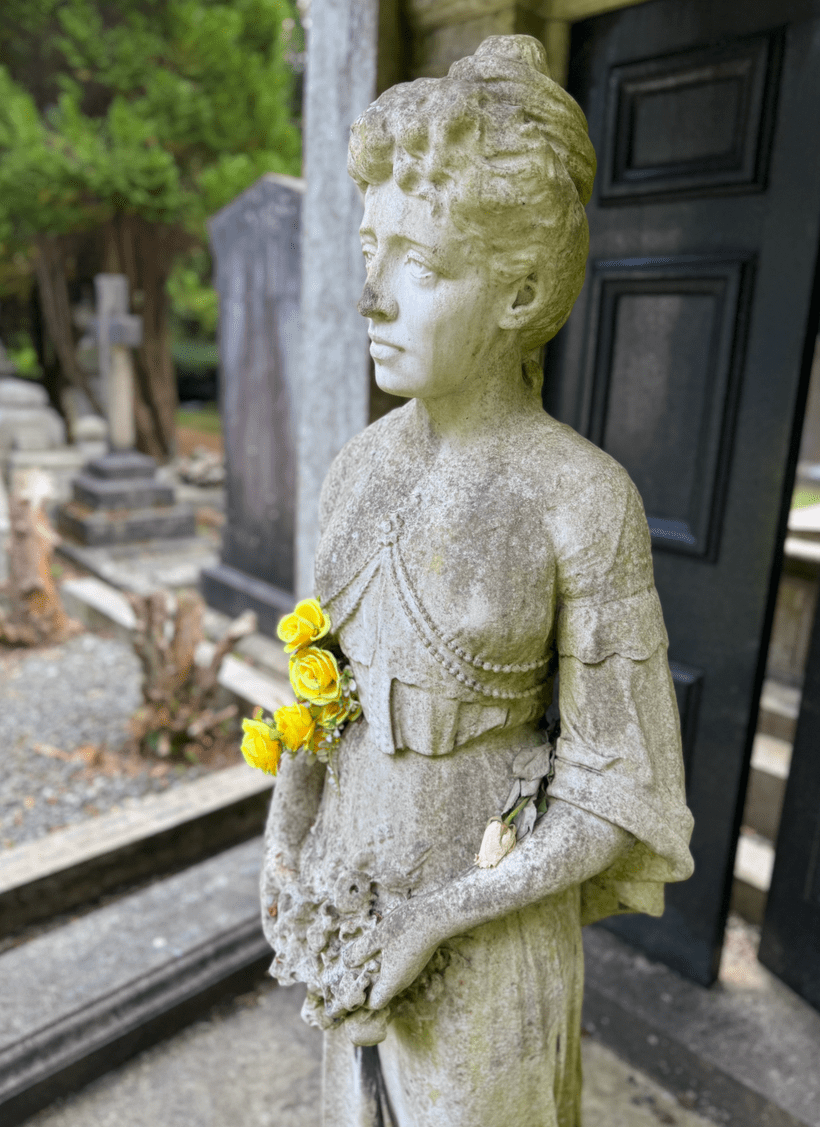
Known as ‘Ethel at the Gate’, the Ethel Preston memorial was installed in 1913, two years after Ethel’s death, and attracted attention quickly. Ethel died on the 24th march 1911 aged 50, and the memorial was commissioned by her husband Walter, who had reportedly been inspired by similar modern effigy graves in Italy. The memorial depicts Ethel herself, holding a bouquet of flowers and dressed in the clothing she wore in a local choir. She stands inside a white Italian marble portico that was reportedly inspired by the same feature at the Preston’s own house (although long since demolished). To the back of the memorial, two black doors are slightly ajar, leading to romantic interpretations of death, the afterlife, reunion and the closeness of heaven. While the name of the sculptor is debated (some sources suggest it was Walter’s nephew), the memorial has retained a level of fame through both its artistic merit and its profundity.
A simple inscription on the right plinth reads:
‘To the dear memory of Ethel, wife of Walter Preston of The Grange Beeston. Died March 24th 1911 aged 50 years.’
The left plinth, a later epitaph reads:
‘To the dear memory of Walter, husband of Emily and the late Ethel Preston. Died Oct 24th 1930.’
However, before the popularity of the memorial as a tourist draw is considered, it’s always worth noting the lives of those left behind. Following Ethel’s death, her husband Walter, a manufacturing chemist, went on to remarry within the year. In an act more befitting of Hollywood scandal than Leeds middle-class happenings, Walter quickly married the couple’s 22-year-old housekeeper, Emily. As such, there is a school of thought that Ethel is carved to look sorrowful as a means of displaying Walter’s regret at his womanising ways. However, knowing a couple of womanizers in my time, I personally believe this regret to be wishful thinking, and Ethel’s memorial should be appreciated for her own funereal merits. Walter Preston married Ethel West in 1882 and the pair had no children. It was thought that the open doors behind Ethel’s effigy would be closed when Walter died, signalling a reunion, but no such changes were made. I can’t imagine it would have been at the top of Emily’s to-do list.

When the monument was first unveiled, it caused quite the stir across Leeds – most memorials had been simple, recognisable styles; headstones, religious symbolism, chest tombs; certainly not an effigy in sight. In the English grave tradition, effigies (likenesses of the deceased) were primarily the realm of the medieval chest tomb, found within churches and cathedrals as knights and people of standing spend eternity carved above their own graves. A beautiful, standing statue was quite the talking point, and thousands of keen grave-cum-art-afficionados flocked to Lawnswood, paying a few pennies[1] each for the opportunity to visit Ethel. So popular was the new memorial that extra trams were laid on to fulfil the needs of keen cemetery-goers, whose enormous queues had to be overseen by police. While queueing to see a grave might seem bizarre today, there are countless examples of grand graves becoming places of public interest following their installation (my personal favourite is the Haagensen Memorial at Laceby that inspired ceramic miniatures.) We have long been a country of souvenir-lovers, especially since the dawn of industrialisation and cheap manufacturing; if we should spend hours queueing to see a grave, the least we can do is buy a postcard to prove it. It’s reported that a local saying sprung from the memorial; if you were stood in the doorway, neither in nor out, you were ‘Standing there like Ethel at Lawnswood’.
Her grave was protected in 1996 when she was officially considered a grade II listed building.
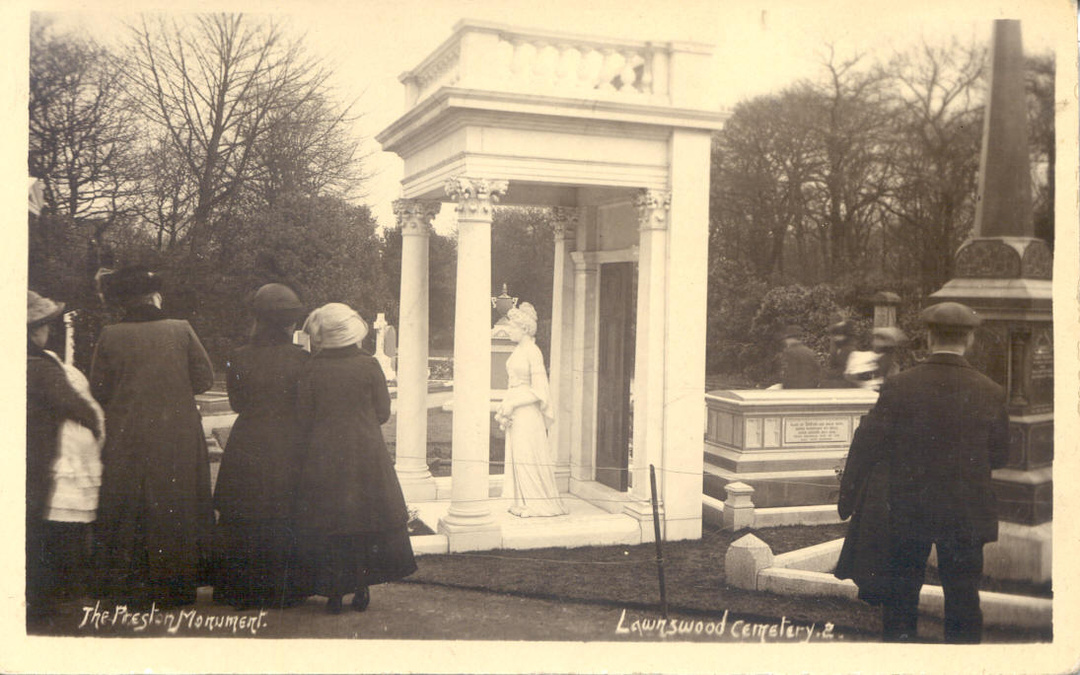
Ethel’s grave continues to receive visitors today, who are drawn in by her beautiful memorial, her curious legacy, or the grotty tale of her husband and the housemaid. But in far nicer traditions, for decades, people have been leaving fresh flowers in Ethel’s arms, alongside her marble bouquet. Countless legends and alternate histories have been spun around the grave; that a marble sculpture of Walter was supposed to join her, that Ethel is depicted waiting for Walter to return from his extra-marital affairs, and countless vague tales of hauntings. While these are all unsubstantiated by fact, the human condition can’t help but want life to be a little more like Eastenders and a little less like dull reality. Nonetheless, visiting Lawnswood today is a truly wonderful experience. While Ethel’s grave is a true show-stopper, there are countless other grand – and modest – memorials that are all worth your time and consideration. I will always sing the praises of a day out at an unfamiliar cemetery; they are places of social history, artistic beauty and contemplation, and Lawnswood is well worth your time.

Liked this post? Then why not join the Patreon clubhouse? From as little as £1 a month, you’ll get access to tonnes of exclusive content and a huge archive of articles, videos and podcasts!
Pop on over, support my work, have a chat and let me show you my skulls…www.patreon.com/burialsandbeyond

Liked this and want to buy me a coffee?
To tip me £3 and help me out with hosting, click the link below!
https://ko-fi.com/burialsandbeyond
***
Useful Links, Resources and Further Reading:
https://friendsoflawnswoodcemetery.org.uk/ethel-preston-1861-1911/
https://livingwithdying.leeds.ac.uk/2018/02/19/remembrance-unique-objects
[1] There doesn’t appear to be an official line on the cost of viewing the grave. Popular estimates are a simple penny, while The Friends of Lawnswood estimate 3 pence.



Leave a Reply